
Tadej Pogačar didn’t just win the Tour of Flanders—he controlled it, once again turning one of cycling’s most complex Monuments into a test of inevitability. His latest victory cements a run of dominance that is beginning to redefine the sport’s hierarchy, raising bigger questions about competitive balance, the role of emerging talent, and whether modern cycling is becoming a victim of its own concentration of greatness. Beyond the podium, Flanders also highlighted shifting generational trends, the growing strength of women’s racing led by Demi Vollering, and the ongoing challenges around media access, audience growth, and the sport’s global future.
Analysis, Insight, and Reflections from The Outer Line.
# Catch up on pro cycling – and its context within the broader world of sports – with AIRmail … Analysis, Insight and Reflections from The Outer Line. You can subscribe to AIRmail here, and check out The Outer Line’s extensive library of articles on the governance and economics of cycling here. #
Key Takeaways:
● Pogačar Continues Dominant Reign
● Younger Racers Largely Shut Out of Cobbled Classics
● Vollering Solos to Victory in the Women’s Edition
● Sports Accessibility: Free Broadcast vs. Subscription Streaming
● Questions About the Future of Sports in the Gulf Region
● Cycling Contributes Almost $7 Billion to U.S. GDP

Over the weekend at the Tour of Flanders, Tadej Pogačar once again reduced one of cycling’s most complex races into a predictable test of attrition – almost casually riding clear of Mathieu van der Poel and first-time Flanders challenger Remco Evenepoel to take a record-tying third title in as many starts. Pogačar’s overwhelming dominance can no longer be viewed in term of winning races; it is now era-defining. With victory at Flanders, he has now moved into second place overall in terms of career Monuments won, with 12, just seven behind Eddy Merckx’s record of 19. Considering (1) he is pacing ahead of Merckx at the same point in their careers, (2) has won the last four Monuments, and (3) has won the last six consecutive major one-day races, he is currently on pace to surpass Merckx’s record in just a couple more seasons. This is a record which was previously – and recently – considered untouchable.
It is becoming harder and harder to argue against Pogačar’s place as the best rider in the history of the sport, considering that he seems to be almost effortlessly winning every stage race he enters, including four editions of the Tour de France. And while the style of racing he deploys can at times feel predictable, if not outright boring, the underlying level of competition is almost impossibly high. What looks like a foregone conclusion often is, in reality, the result of the sport’s very best riders pushing each other to extremes rarely seen in cycling history. When riders like Remco Evenepoel change their plans to take part and then finish on the podium, it is pretty clear that we are watching a race where the absolute top tier of the sport are pushing each other to the limit at nearly every race. In fact, the top five at yesterday’s Flanders race (including, beyond the podium, Wout Van Aert and Mads Pedersen) was likely the highest-quality collection or riders in any recent one-day race. This has led to an uncomfortable paradox; at least recently, as the concentration of top performers becomes very high, the racing tends to become more boring and predictable.

Remco Evenepoel was one of only 3 riders under the age of 30 to finish the the top 10 at Flanders.
But beyond Pogačar’s growing dominance, Sunday’s results hinted at something a bit more unusual; to a significant extent, the race was determined by established stars in their early thirties and beyond. In a sport that is increasingly being reshaped by a wave of young talent – where riders barely out of their teens are already demanding multi-million dollar contracts – the cobbled Classics remain conspicuously resistant to this generational turnover. In fact, amongst the top ten on Sunday at Flanders, only three riders were under the age of 30; however, that did include two of top three – Evenepoel at 26 and Pogačar at 27. Evenepoel, like Pogačar, has previously shown that the skill and power used in stage racing can be transferred over to even the most technical one-day races like Liege. Hence, it is a bit baffling why this wave of young talents has yet to really translate its success to Flanders or Roubaix. At the moment, there appears to be a strange inversion: stage racing is being taken over by younger riders while one-day racing is becoming the refuge of the sport’s older, established, and perhaps more skilled hierarchy.

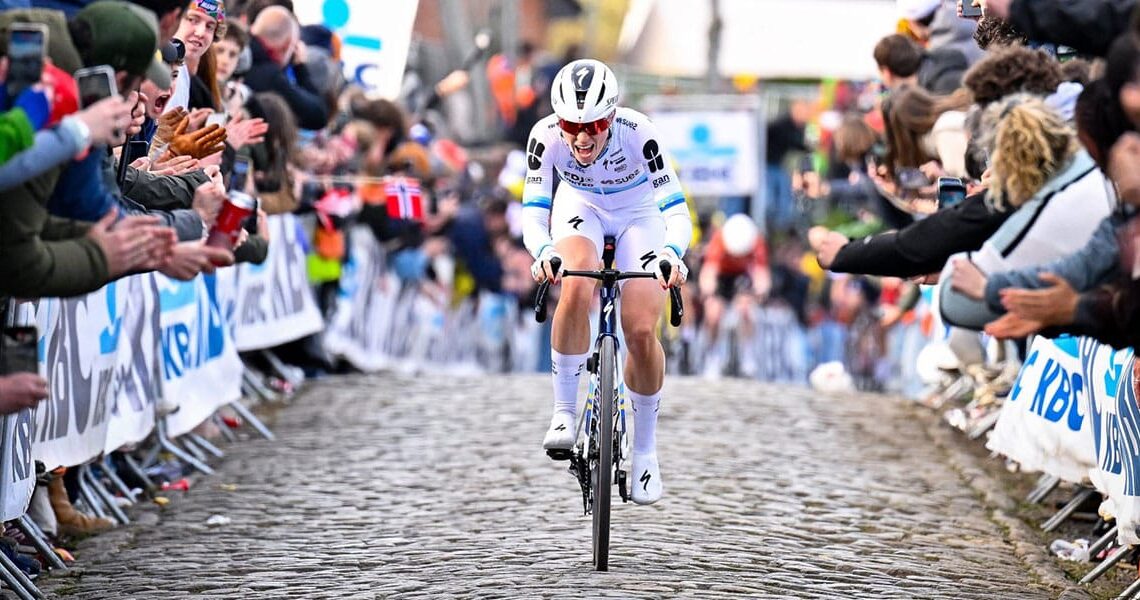
The Women’s Tour of Flanders lived up to all the hype and anticipation, after a spring marked by the rising form of many star riders and a sense of parity among the peloton’s top teams. Crashes shaped the race’s final outcome, as Dwaars door Vlaanderen winner Marlen Reusser exited with a back injury and Lorena Wiebes abandoned from a hard fall, allowing Demi Vollering to confidently solo to the win. The FDJ star took a perfect lead-out from teammate Franziska Koch to break free on the Kwaremont, distancing Pauline Ferrand-Prevót and Puck Pieterse by 42 seconds at the finish. Vollering proved two facts with her dominant win – that pivotal rider acquisitions over the past year have bolstered her FDJ’s team’s strength to a new level, suggesting that other teams are going to have to invest more in talent development to match FDJ’s current winning formula. To be fair, SD Worx originated this formula, once boasting a roster that included Vollering, Anna van der Breggen, Lotte Kopecky, and Wiebes all on its front-line and a cadre of top women in the support tier. However, with Van der Breggen still returning to form after a short retirement, Kopecky seemingly having plateaued, and Wiebes only a certainty for sprint wins, FDJ’s balanced team is poised to dominate the rest of the 2026 season. The women’s Paris-Roubaix next weekend may favor the individual strengths of Pieterse and defending champion Ferrand-Prevót, but the Ardennes week of Amstel, Liege, and Fleche seems like it could be Vollering’s to lose.
The crowds that packed into Flanders’ well-planned and fan-friendly finishing circuit were among the deepest seen lately for a professional cycling event. But the notion that they were all there just to see the men’s battle is disingenuous; as we noted last week, the NWSL set multiple season-opening stadium attendance records, and on Thursday last week, Barcelona Femeni filled a home crowd of over 60,000 fans when it trounced rival Real Madrid 6–0 in the UEFA Women’s Champions League quarterfinal. In the same timeframe, the women’s NCAA basketball tournament pulled down record viewing numbers for ESPN, even as Sunday’s title game final numbers are being tallied. As we await final viewership numbers from the men’s and women’s Flanders television and streaming time slots, it’s worth noting that recent editions of the women’s race have pulled viewership numbers equal to or greater than the men’s event. Barcelona Femeni is playing in a newly renovated stadium and packed it to the rafters, and many other women’s teams in soccer and basketball are actively investing in or constructing new venues to meet fan demand. The question in women’s cycling will continue to be, how can it attract investment to further develop the sport and tune it for modern sports audiences, while building its talent pipeline to sustain momentum?
One of the most promising avenues for developing pro cycling’s audience reach has been via streaming, and it has quickly become the de facto standard for connecting to the sport as free-to-air and terrestrial broadcasting avenues have disappeared. Last week, CBS Sports made the surprising announcement that it would be pivoting to broadcast more of The Masters golf tournament on Amazon Prime Video – its streaming partner for the venerable event. There are two critical takeaways from this strategic move for pro cycling to take heed of, not the least of which is that competitive road cycling has long shared an association with the economic and age demographics of golf fans: older, affluent, and willing to spend money on content and tourism around key events. The Masters has long taken a conservative and exclusive media approach, but this move suggests that the tournament’s owners are concerned that its reach may have plateaued, with increased competition from other sports. This move may help to bolster affinity with existing golf fans, but limited prime-time viewing through more accessible broadcast channels could hurt golf – in the same way that streaming may be a constraint to pro cycling’s growth. In summary, sports have to be cognizant of only catering to existing fans, without a more cohesive strategy to grow their total audience.
Speaking of televised sports, a recent survey by Fox Sports underlines the confusion and frustration that many sports fans are increasingly experiencing, as more and more events migrate from free TV and basic cable into various forms of subscription streaming services. According to this national survey, significant majorities of both fans and non-fans believe that major sports should stay on free broadcast television, rather than behind streaming paywalls. The price of such streaming services is becoming a significant negative for many sports fans – as we have discussed numerous times in the past with respect to cycling. But the frustrations clearly go beyond that; nearly half of all fans interviewed said that they often skip games simply because it was too difficult to find or access them. Since nearly three-quarters of all registered voters consider themselves sports fans, it seems that this is serious concern that should be on the minds of both the sports leagues and organizers, as well as the broadcasters and streamers.
As the conflict in Iran drags on, more questions are being raised about the impact of sports in the Gulf area. Originally conceived and built as an instrument of soft power, regional sport is now turning into more of a strategic exposure. Among the events still scheduled to be held in the relatively near future is the Asian Football Cup in Saudi Arabia, and the FIBA Basketball World Cup in Qatar, both scheduled to played in 2027. And the questions extend beyond whether these events will actually be held; just as important is whether many fans would attend even if they were held, and participant concerns about the hosting capabilities of the home country, and so on. If doubt begins to creep in to some of these areas, the events may be doomed even if they remain on the calendar. Sports have always been intertwined with politics, and these Middle Eastern countries have been trying to exploit that relationship to project stability and global influence. But the current situation is challenging all of those objectives, and it remains to be seen whether the general Gulf region will be able to sustain its recent and dramatic push into international sport.
According to www.bicycleretailer.com, the general sport and activity of bicycling added some $3.7 billion to the United States economy in 2024, up slightly from the year before. Meanwhile, the overall outdoor recreation sector of the economy added some $1.3 trillion of value. According to industry advocate www.peopleforbikes.org, the broader U.S. bike market, including bike manufacturers, independent and mass retailers, and direct-to-consumer product manufacturers were estimated to represent more than $7 billion in revenues.

All sports aficionados love good merchandise and gimmicks, but sometimes things can go a little too far. The new OKAPA water bottle, produced by a California start-up, recently announced the introduction of the “Ferrari of water bottles” – which will retail for a mere $300. The company claims it that it has a “breakthrough design, unique materials and enhanced hygienics.” It has a medical-quality Grilamid spout (whatever that is?), high-grade shock resistant glass, silicone base and an aluminum sleeve. It weighs 17 ounces and is non-insulated. Perhaps a Christmas gift for the high-end runner or cyclist on your list who already has everything?
Written and Edited by Steve Maxwell / Joe Harris / Spencer Martin
THE OUTER LINE
www.theouterline.com
@theouterline
Visit our website for our latest articles and commentary. And check out our extensive Article Library for hundreds of in-depth articles about the economics, governance, structure and competition of pro cycling, organized by subject. (Advisory Group: Peter Abraham, Luke Beatty, Brian Cookson OBE, Nicola Cranmer, Prof. Roger Pielke, Jr., Dr. Bill Apollo and Prof. Daam Van Reeth.)
The post The OUTER LINE: Is Pogačar Making Cycling Too Predictable? Flanders Signals a New Era appeared first on PezCycling News.