
If there was any doubt about Tadej Pogačar’s place in cycling’s all-time hierarchy, his stunning victory at Milan–San Remo may have just settled it. Crashing before the Cipressa, chasing back, and then detonating the race anyway, Pogačar delivered a performance that was equal parts chaos, control, and cold precision. But beyond the headline win, the weekend offered much more: a masterclass in course design, warning signs from crashes in the women’s race, fresh ideas in sports media from the Cape Epic, and bigger questions about athlete power and cycling’s future leadership. It’s all in this week’s AIRmail.
Analysis, Insight, and Reflections from The Outer Line.
# Catch up on pro cycling – and its context within the broader world of sports – with AIRmail … Analysis, Insight and Reflections from The Outer Line. You can subscribe to AIRmail here, and check out The Outer Line’s extensive library of articles on the governance and economics of cycling here. #
Key Takeaways:
· Pog’s March to Greatness Continues
· The Magic of the Milan-Sanremo Course Design
· Women’s MSR Marred by Crashes
· TV Content Insights from the Cape Epic
· The Importance of Athlete Organization
· Bicycle Leadership Conference

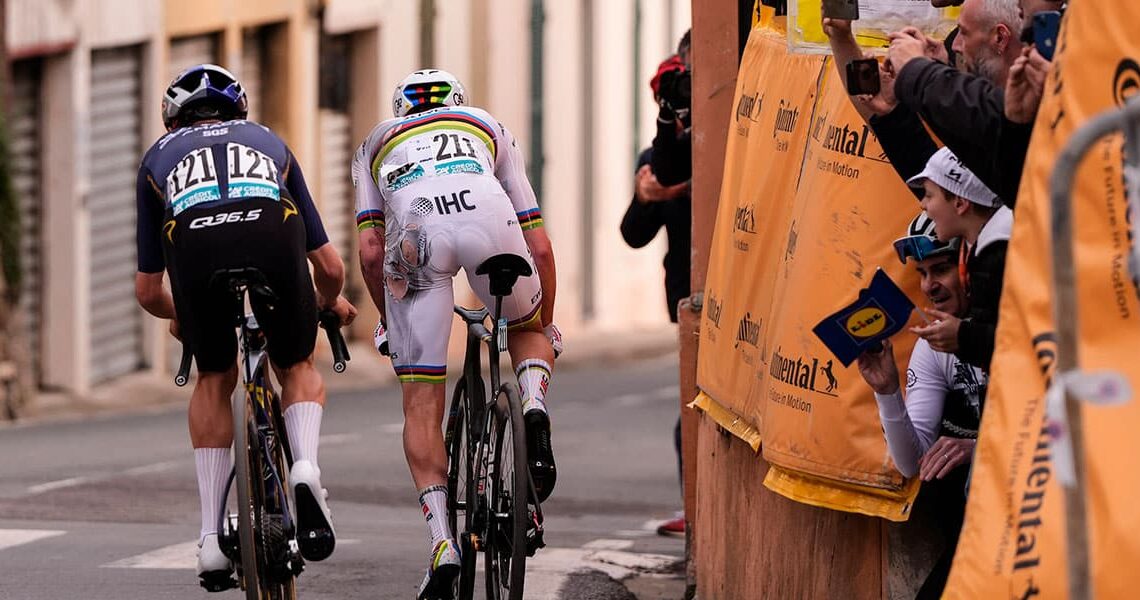
On the Ligurian coast over the weekend, Tadej Pogačar finally solved one of cycling’s most stubborn puzzles – winning the 2026 Milan-Sanremo in a performance that may come to define not only his 2026 season but also his broader place in history. After crashing before the base of the famed Cipressa climb – at the most critical moment of the race – Pogačar executed one of the most stunning comebacks in modern cycling history. Calmly remounting, he paced his way back through the field with the help of his UAE teammates, immediately resuming control of the race. He then launched a decisive move on the Cipressa that only Tom Pidcock and Mathieu van der Poel could follow. By the Poggio climb, however, the cumulative effect of UAE’s relentless pace had taken its toll; Pogačar was able to drop Van der Poel and then outsprint Pidcock on the Via Roma to secure a narrow victory – his first at cycling’s longest and most tactically elusive Monument. He thus took a major step toward completing the career Monument sweep, which has been achieved by only three riders – Eddy Merckx, Roger De Vlaeminck, and Rik Van Looy. He also kept alive, at least for the moment, the far more elusive possibility of a single-season Monument sweep.

More than just another win for Pogačar, this was a clear demonstration of the control, resilience, and precision under pressure that now define his career – a victory in a race that further underlines his growing dominance of the sport. With eleven career Monument victories at just 27 years of age, Pogačar now sits second on the all-time list behind Eddy Merckx and, at his current pace, is on track to match or even surpass Merckx’s benchmark of 19 by the end of the decade. What once felt like a theoretical debate is quickly becoming a practical one. That debate is not about whether Pogačar belongs among the greatest riders of all time; rather it is about whether he will ultimately surpass the sport’s most enduring benchmark – Eddy Merckx – to become the consensus greatest rider in history.

The recognition and visibility of Pog’s accomplishments are starting to rise above and beyond the narrow cycling world, and today even drew notice in the Yahoo Sports newsletter, which normally doesn’t even come close to covering professional cycling. The summary highlighted Pogacar’s “comically” successful career, again pointing out that all he needs to match Eddy Merckx’s career is a victory at the Vuelta and at Paris-Roubaix. And some people have already made up their mind; the article quoted former British champion Adam Blythe as saying that “we throw the term around, but he is the greatest of all time without a shadow of a doubt. There is no rider we can compare to him. He is just untouchable.”

Beyond the historical implications, the race also pushed back against the growing narrative that Pogačar’s dominance is draining the sport of uncertainty or any excitement. Instead, the final 30 kilometers of MSR delivered one of the most compelling spectacles in recent memory, with nearly all of the sport’s top riders in contention each with plausible paths to victory. Even in defeat, the chasing cast offered some intriguing signals for the months ahead – with Pidcock appearing to unlock a new ceiling in these hybrid finales, Van Aert returning to the podium after ankle surgery with a late charge that nearly closed the gap, and Lidl-Trek’s Mads Pedersen orchestrating a disciplined chase that hinted at a potential blueprint to challenge Pogačar’s long-range attack in the future. Just as importantly, the race served as another reminder that its comparatively “mild” course – an outlier in an era of ever-increasing difficulty – remains one of the sport’s most effective course designs, keeping a wider range of riders in contention and forcing even the strongest to take risks in order to win.

The Milan-San Remo women’s race was also marred by crashes, and it did more than just influence the outcome by disrupting the race’s tactics — it sent Italian Debora Silvestri to the emergency room. Her spectacular head-first tumble over a road barrier on the Cipressa brought home the dangers of open road racing for riders and fans alike – more than the wreck which delayed many of the men’s favorites later in the day. Silvestri sought to avoid the crash that put favorites like Kasia Niewiadoma Phinney on the deck, and when the race reformed, Lotte Kopecky of SD Worx-Protime hammered out a brilliant sprint win over a reduced group that included Noemi Rüegg (EF) and Puck Pieterse (Fenix-Premier Tech). Kopecky has amassed a brilliant palmares of road wins over the past five seasons and has improved as a climber to the point where she will be a serious challenger in both the Flemish and Ardennes Classics this April. How well she shares team leadership with Anna van der Breggen, herself a former Flanders champion and multi-time winner in the Ardennes, remains to be seen but it will be one of the exciting subtexts to watch unfold as the Women’s WorldTour continues to heat up.
South Africa was an unlikely focus in the sporting universe last week as both LIV Golf and the Cape Epic mountain bike stage race concluded this weekend. LIV Golf is as disruptive a force as ever in championship golf play, with PGA Tour star Bryson DeChambeau winning the Johannesburg stop in an exciting playoff. The event sold over 90,000 tickets and fans were raucous as DeChambeau played for the win. Meanwhile, the Cape Epic presented riders with an incredibly challenging route across the Karoo region, finishing with three stages in the Stellenbosch wine country. The “home” team of Matthew Beers and Tristan Nortje won the men’s Elite division, while Candice Lill and Alessandra Keller took the women’s honors. The format of the race (2-person teams), course terrain diversity and level of difficulty made for exciting viewing — the race was streamed for free on YouTube but what really stands out is the post-live production race highlights content. The production team did an incredible job of stitching together cohesive storytelling for the seven stages, mixing human interest segments, key racing highlights, and details about the region, race organization, and sponsors in a way that – frankly – hasn’t been done very well since CBS and ABC produced Tour de France weekend highlight shows in the late 1980s. Pro road cycling content producers would do well to study these race summaries and look for opportunities to improve the broadcast output beyond the live presentation to delight fans and inspire new ones.

Collegiate athletics has become a multi-billion dollar sports entertainment engine since NIL rulings and the House vs. NCAA case completely upended its economics and traditional structure. But that hasn’t stopped NCAA leaders from lobbying Congress and even wooing the President to prevent the athletes from being recognized as university employees, unionizing, or gaining more power in the evolving system. A recent article in Front Office Sports highlights many of the reasons why athletes should seize the moment to unionize and negotiate a collective bargaining agreement now. According to former National Labor Relations Board general counsel Jennifer Abruzzo, the players’ “labor is what allows this profit-making enterprise to exist.” Key goals of unionization and a Collective Bargaining Agreement include a greater share of the revenue, health and safety issues, and a seat at the leadership table to steer decision-making that would affect athlete freedom of movement and academic opportunity. In pro cycling, the central issue blocking forward progress is that the UCI doesn’t grant rider representation a voting seat in any of its key committees – only an advisory presence. Thus we can see a parallel in what may happen next in the NCAA as athletes mobilize to gain legal status and press for unionization. The question for pro cycling is, what critical event needs to take place for the riders to rally behind a strong leader and take on the UCI – to move beyond the so-called “joint agreements” and achieve that kinds of real and transformative changes that CBAs have yielded for athletes in nearly every league sport in the world?
Last week the annual Bicycle Leadership Conference took place in Dana Point, California. This gathering, put on by bike industry trade and advocacy organization PeopleForBikes, brings executives together from around the world. This year’s event featured Giant Group CEO Phoebe Liu, SRAM CEO Ken Lousberg as well as keynotes from former Airbnb executive Chip Conley and former Tesla President Jon McNeill. The two dominant topics at BLC were e-bikes and cycling infrastructure. As e-bikes have become popular around the world, regulation has become more important: speed, battery safety and the new eMoto category are all issues on the table at both state and local levels. And the entire industry now understands that it can’t grow without safe places for people to ride. While federal spending for bike and pedestrian infrastructure in the U.S. has grown by three or four times over the last twenty years, we’re still nowhere near the level needed to keep pace with European cities. Both London’s efforts around the 2012 Olympics and Paris’s transformation to a bikeable city to coincide with the 2024 Games were cited as inspirations for Los Angeles 28. But with many hurdles to clear before the LA28 Games, it remains to be seen if the city can create the infrastructure needed to accommodate the influx of tourists and athletes.
Written and Edited by Steve Maxwell / Joe Harris / Spencer Martin
THE OUTER LINE
www.theouterline.com
@theouterline
Visit our website for our latest articles and commentary. And check out our extensive Article Library for hundreds of in-depth articles about the economics, governance, structure and competition of pro cycling, organized by subject. (Advisory Group: Peter Abraham, Luke Beatty, Brian Cookson OBE, Nicola Cranmer, Prof. Roger Pielke, Jr., Dr. Bill Apollo and Prof. Daam Van Reeth.)
The post Outer Line: Pogačar’s San Remo Masterpiece, Cape Epic Insights & Cycling’s Power Shift | PEZ AIRmail appeared first on PezCycling News.